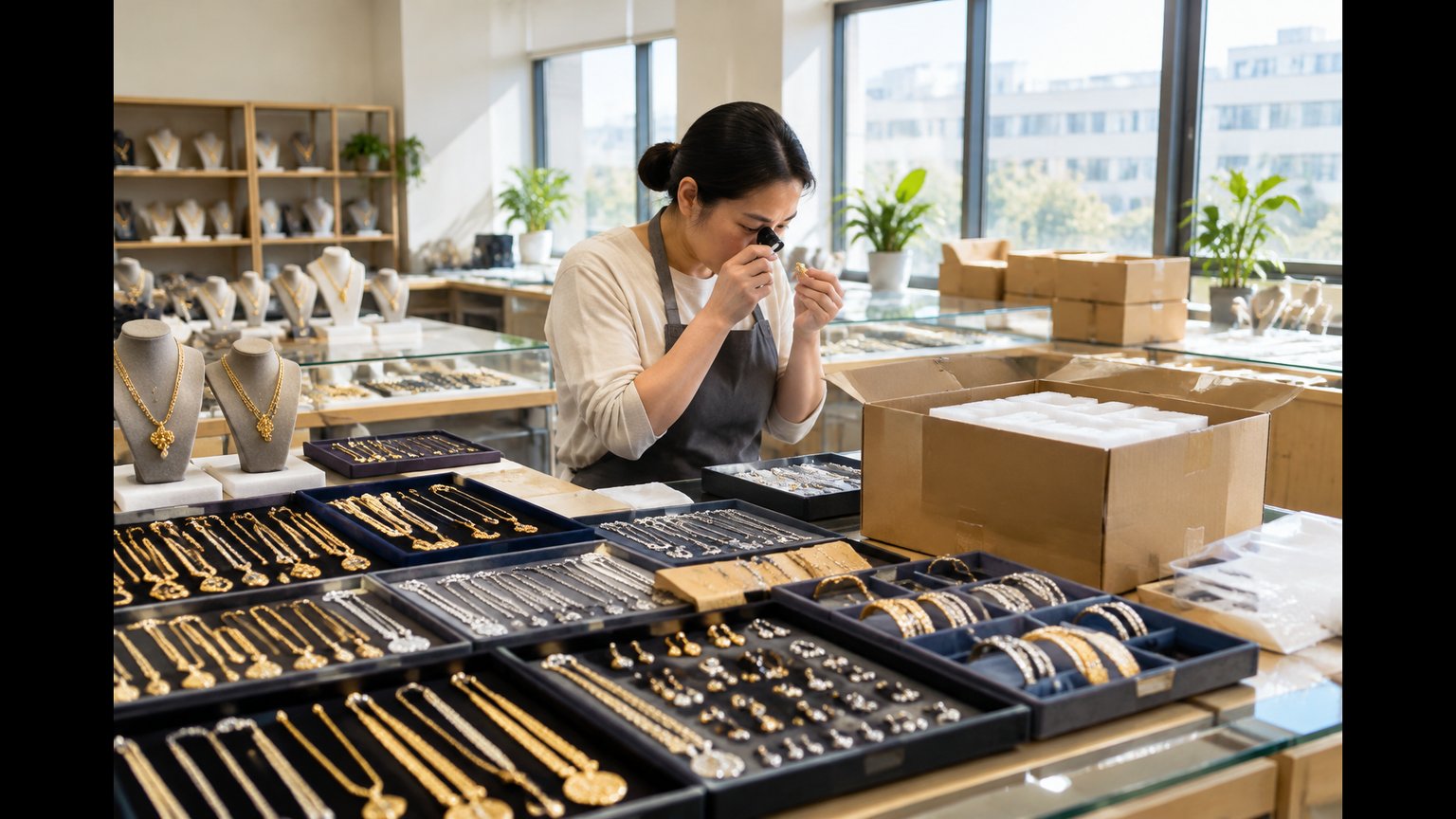
If you're reading this because you're about to place your first wholesale jewelry order — or because the last one ended badly — you're in the right place. I run a jewelry factory in Yiwu, Zhejiang. Over the past twelve years I've watched the same handful of mistakes kill otherwise good orders, and they're almost never about price. They're about not knowing what you're actually buying, and not asking for the right things on paper.
Fair warning up front: I'm not going to tell you every Chinese factory is great, because they're not. I'm also not going to tell you that sourcing here is a minefield, because it doesn't have to be. What follows is the boring, practical middle ground — the kind of conversation I'd have with a buyer over tea before we ever talk numbers.
Before Anything Else: Know What You're Actually Buying
The fastest way to lose money in this business is to compare two quotes that aren't for the same product. "Gold-plated necklace" can mean a 0.05 micron flash of color on zinc alloy, or a 3 micron plating on polished brass. Same words, wildly different cost, wildly different customer experience.
Here is what we actually make our products from, and what each material is good for:
| Base metal | What it's good at | Watch out for | Typical price per piece (pendant-scale) |
|---|---|---|---|
| Brass (copper alloy) | Weight and a premium feel; takes a beautiful polish; holds detail well | Oxidizes bare, so it always needs plating | $0.30–$1.20 |
| Zinc alloy | Cheap, casts complex shapes easily, perfect for fashion lines | Feels light; can look dull over years of wear | $0.20–$0.80 |
| Stainless steel | Nearly allergy-free, tough, great for earrings and men's lines | Hard to engrave fine detail; limited to certain finishes | $0.15–$0.50 |
| 925 silver | Keeps resale value, suited to mid-to-high price points | Cost is 10–20x base metal; market price swings | $4.00–$20.00 |
If you're about to ask "is it real gold plated?", you've asked the right question. The answer that matters is thickness, not the word "gold". Common plating tiers: a thin flash of color (roughly 0.02–0.05 micron) that's decorative and cheap; standard plating around 0.1–0.3 micron, which is what most fast-fashion jewelry ships with; and durable plating at 1 micron or above, which is what you want if your customers expect a piece to survive a season of daily wear. When a factory quotes "18K gold plated", that's a color description, not a promise about content — the actual gold content is the thickness, and thickness should be on the quote.
Same logic applies to stones. Cubic zirconia, glass, and Swarovski crystal are three different budgets and three different light responses. "Crystal" is not automatically Swarovski — that's a brand, not a material. If your price point matters, say "CZ" or "glass" out loud and let the supplier price it honestly. You can see how we spec these in the product catalog.
The MOQ Conversation Nobody Wants to Start
Minimum order quantities are where a lot of buyers get emotional, so here's the factory math behind them. Every new style costs us money before the first piece is cast: design review, model making, molds that might run hundreds of dollars, plating test runs, and the people who package your parts. That cost gets spread across the pieces of your order — so the MOQ is really just "the order size where the fixed cost stops eating the margin on both sides".
Rough expectations at most Yiwu factories, including ours: in-stock / catalog styles start around 50–200 pieces. ODM (modified) versions of existing styles usually start around 200–500. Fully custom pieces with new molds are typically 500–1,000. High-end silver and gem-set work goes higher, because the material risk is higher.
If those numbers make you nervous, good — you're thinking like a buyer. Start small. A 200-piece test order that tells you what actually sells is worth more than a 2,000-piece order that sits in your warehouse. Every factory owner you meet would rather take your second order than your first one anyway; that's where the relationship actually becomes profitable.
How to Read a Quote Like a Buyer, Not a Tourist
Most quote problems aren't dishonesty — they're omission. A price looks great until you realize what it didn't include. Before you compare two quotes, make sure both suppliers have confirmed, in writing:
- Base material and grams per piece (weight changes price dramatically)
- Plating type, color, and thickness — in microns, not adjectives
- What packaging is included — poly bag, card, box, or nothing at all
- Stone type and grade, if any (CZ, glass, crystal, genuine)
- Price steps by quantity — the per-piece price at 500, 1,000, and 5,000 pieces
- Whether the decoration (logo stamping, engraving, enamel) is included
- Quotation validity and currency — RMB or USD, and whether the price is locked
- Production time from sample approval, not from "order confirmed"
One phrase to be careful with: "or similar." "Brass or similar" is not brass. "CZ or similar" is not a grade. If the spec sheet is vague, ask for it in writing before you pay, not after the first production batch arrives.
Factory or Trading Company? Both Can Work
Yiwu is famous for trading companies — hundreds of them sit between you and the actual workshops, and many are perfectly professional. But you should know which one you're talking to, because it changes your leverage: a factory can show you the plating line, the mold room, and the order your style is being produced against. A trading company can only show you photos.
How to tell, politely: ask for a video call inside the workshop, ask how many production lines they run, ask for the business license company name and check whether it matches the "factory" on the letterhead, and place a small test order first. A real factory takes production seriously; a middleman can still be a good partner, but you want to know what you're paying for.
At our shop you're welcome to do all of the above — video walk-throughs, test orders, even visits if you're in the area. Start a conversation on our contact page.
Samples Are Cheap Insurance, Expensive Regret
The buyer who skips sampling because "the photos are clear enough" is the buyer we later have a difficult conversation with about plating shade. A physical sample is the only document that can't be misinterpreted. When you get yours, don't just look at it — do something with it:
- Wear it for a couple of weeks, including sweaty situations, to see how the plating and stones hold up
- Put it under bright light and check edges for plating skips and rough casting
- Test the closure, jump rings, and any moving parts repeatedly
- Compare the sample to your reference photo side by side — color memory lies
- Ask for the sample's plating thickness confirmed in writing, and keep it
Sample fees are the industry norm and usually modest; many factories, including ours, deduct it from your first bulk order. That's not a hidden cost — that's the same logic as insurance.
QC: Make the "Good Enough" Bar Obvious
Mass production always produces a few imperfect pieces; the question is what fraction you'll accept. Most importers work with AQL sampling (acceptance quality limit), with 2.5 being a common standard for costume jewelry: for an order of 1,000 pieces, you inspect about 80, and you reject the lot if more than roughly 5 are defective. If you don't have an AQL spec, we suggest you set one before production starts rather than after the goods arrive.
What to tell the factory to check on its end: plating coverage on recessed areas, soldering points, stone grip, clasp spring-back, and consistency of the packaging. And always request shipment photos: cartons, inner boxes, and a few opened units.
Shipping From Yiwu: Small Box to Full Container
| Method | Good for | Rough cost | Typical transit time |
|---|---|---|---|
| Express courier (DHL / FedEx / UPS) | Samples, small restocks up to ~20kg | $25–$45 for 1kg to EU / US | 4–8 working days |
| Air freight | Mid-size orders, ~50–500kg | Roughly $5–$9 per kg, volatile | 7–12 days |
| Sea freight (LCL or FCL) | Orders above ~2 cubic meters | Depends heavily on route and season | 25–45 days |
One overlooked advantage of Yiwu: it's the world's largest small-commodity market, so consolidating several styles from different suppliers into one air or sea shipment is routine and cheap.
Red Flags: When to Walk Away
- A price lower than the raw material cost — there's a trick hiding somewhere (usually weight, plating, or stones)
- Payment terms of 100% in advance with no sample, no written spec, no company track record
- A supplier who won't do a video call or share production photos while claiming to be a factory
- Promises that everything will look "exactly like the photo" while refusing to make a sample
- Compulsory exclusivity for products you designed, without a written license or buyout agreement
One more piece of advice, and it's the one we give every first-time buyer: don't optimize for the cheapest supplier, optimize for the one that answers questions in writing. Price differences shrink with quantity; communication problems compound.
FAQ
What's your minimum order for catalog styles?
Most in-stock styles start at 50–200 pieces depending on the item. We're happy to start with a small test mix so you can validate before committing.
Do you refund sample fees with the first order?
Yes, at our factory the sample fee is deducted from your first bulk order. We ask you to pay upfront because unpaid samples have a way of never turning into orders.
Will gold plating fade?
Honest answer: every plating eventually wears — that's physics, not a defect. The question is how many months of normal wear it survives. Standard 0.1–0.3 micron fashion plating is a season; 1 micron or better holds up for a year or more of daily wear. We'll tell you which one your budget can buy, and we'll write it on the quote.
Can you put my logo on the jewelry and packaging?
Yes — logo stamping, engraving, cards, boxes, and poly mailers are all standard. See our services page for what's included at each quantity level.
I'm just starting. What's your advice?
Buy small, buy stock styles you can test locally, sample first, and pay by stages (deposit + balance). Once you have data on what sells, then talk to us about private labeling and custom molds.
The Honest Closing
We're not the cheapest factory in Yiwu, and we're not trying to be — cheap and consistent rarely live in the same building. If you want a supplier who writes specifications down, shows you the workshop, and treats your first 300-piece order with the same care as a 30,000-piece one, that's what we've been doing since 2013. Send us a note with what you're trying to build, and we'll tell you honestly what it takes.